by cfh@provide.net, 06/16/01. Copyright 2001 all rights reserved.
Scope.
Some of these ideas were originally conceived by Jonathan Deitch. He has a nice Twilight Zone "fix it" web page at http://personal.atl.bellsouth.net/atl/j/d/jdeitch/tz-fixit.html. I have been collecting many other people's ideas on this modification too. So most of this stuff is not "my idea". This is an accumulation of lots of TZ Slot Machine switch modifications I have seen.
|
1. If Welding is Needed
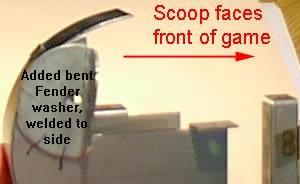
There are some (welding) modifications that can be added to the slot machine scoop, if it already needs to be welded. First, a two inch fender washer can be added (welded or even JB Welded) to the side of the scoop to help strengthen it. The front of the washer can protrude in front of the scoop metal about 3/8", and be bent to the left (as installed, and playing the game). The bent edge is slightly trimmed off too. With the scoop installed in the game and a brand new Williams target installed, bend, cut, and fit the washer to its place. Then mark the washer's position with a "sharpie" and remove the scoop for welding. This will help prevent the scoop from breaking again, as the bent washer will be gently deflect the ball to the side.
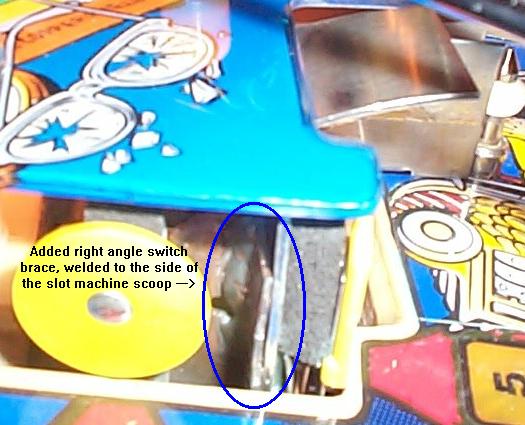
A metal bracket can be welded perpendicular to the side of the slot machine scoop, preventing the switch from bending back ever again. To do this, first bend the slot machine switch target back to its original position. Then draw a line on the side of the scoop even with the back of the slot machine switch target. Take the scoop out, and construct a right angle metal (stainless steel) bracket. Hire someone that does TIG welding, and have the bracket welded in place on the slot machine scoop (and weld the scoop back together where the original Williams tabs broke).
2. If Welding is NOT Needed.
The Capcom standup target is available from Prestige Industries 248-542-5530 (www.pinball4u.com) or Mantis Amusement www.mantisamusements.com). This target is used instead of the Williams target because it has an "L" shaped steel reinforced back, and is less likely to bend. Sega standup targets also use this "L" shaped reinforced back, but the switch target itself is a different style (and therefore is not recommend). I have not personally tried this, but the Sega target metal back may also be used in this manner. If a Sega target is the only target available, perhaps the "L" shaped back can be unbolted and then attached to the original Williams target. The Williams slingshot hinge bracket can be a used part. A very common part found on all Williams pinball games from the 1980s to present. The 1/4" heat shrink tubing is good to have around. I used this size tubing for repairing Williams flipper pawl assemblies. This tubing is needed for the part of the flipper pawl that contacts the flipper EOS switch. The coin box metal lid should have come with the game. It is a metal top to the coin box, with slots cut for coins to fall through. If using this lid is not desired, 1/8" stainless steel wire rod can be purchased at a local welding shop.
Do All The Steps Need to be Done? This is assuming the slot machine scoop was not welded, and did not have a welded brace installed, as describe above (if these welding mods were done, the rest of these modifications are probably not needed). Williams stand-up targets use a flat metal back. When hit hard with a pinball, the back will bend. When Capcom made pinball games a few years ago, they improved on this design. Instead of using a flat target back, they used an "L" shaped back. This prevented the switch back from bending. The only problem with the Capcom switches is they are "two lug" switches (opposed to Williams switches which are "three lug" switches). This is not a problem though! The third lug on Williams switches is only a "place holder" for one end of the switch's diode. The two lug Capcom switches can be used, but the diode must be installed correctly. Capcom switches are very plentiful. When they stopped making pinball games, their excess inventory was dumped on the parts market. Many retailers bought these parts cheaply.
Installing a Diode on the Capcom Switch.
If either of the two following steps are done, the Capcom "L" switch back needs to be modified. The modification involves "reversing" the back plate (the other two steps require this modification). Here are the steps:
From the bottom of the playfield, remove the slot machine standup target switch. This is held in place with two 1/4" hex screws. In order to remove this switch, the playfield lamp circuit board next to the switch must be removed first. Fit the new switch into place with the same screws. The mounting holes are in the same position as the original Williams switch, so the Capcom switch will fit exactly the same.
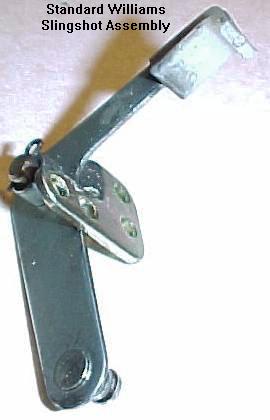
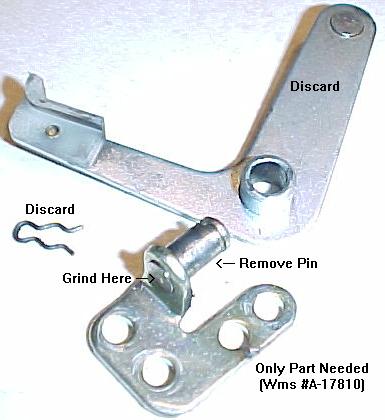
If the slingshot hinge bracket is not ordered separately (Williams part number A-17810), a standard Williams slingshot assembly can be taken from a "parts" game.
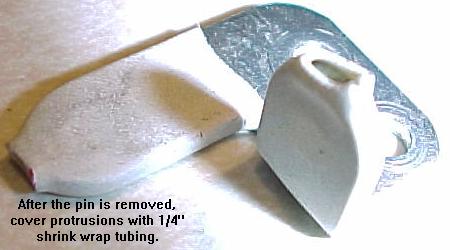
Once the hinge bracket is isolated, the pin which holds the "L" shaped kicker arm needs to be removed. Using a bench grinder, grind off the end of the pin. This will allow the pin to be easily knocked off the bracket with a hammer.
Install the sling shot bracket behind the switch, as pictured below. It should just fit into place snugly. Because we reversed the "L" shaped switch back, the sling shot hinge bracket should have no mounting problems.
2c. Installing a Reinforcement Brace.
Target Reinforcement Brace, using a Coinbox Lid.
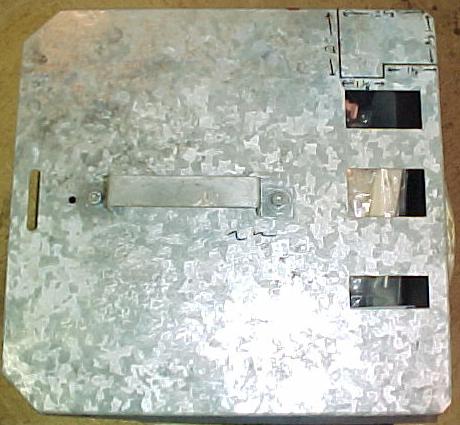
Obtaining Some Metal. The one part on every 1990s game I find NO use for is the coin box lid. I'm sure it has great usefulness for operators, but for me, it's just something I set aside and never use. I do use the coinbox to throw parts in, but the lid just gets in the way. So here's my metal! Not as thick as I would like to use, but hey, it's there! The rolled metal edges work perfect too for this application (yes, it does matter which corner of the coin door is used; see the picture below).
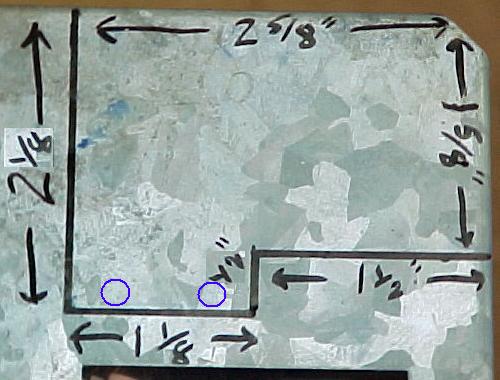
The piece of metal that needs to be cut should be 2 1/8" high by 2 5/8" wide. Then use the picture below to cut the metal to proper shape. It is not a rectangle, as there needs to be a 1/2" high by 1 1/8" wide "tab" coming off the rectangle.
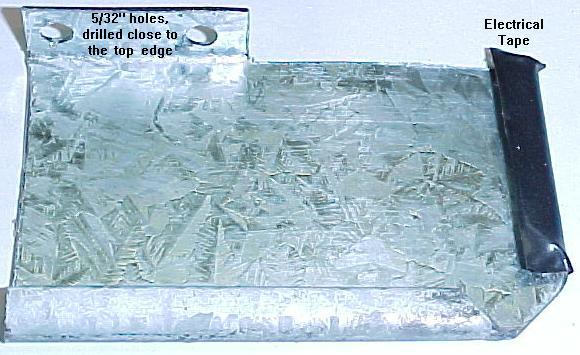
Bend the Metal Tab. After the tab is bent, put a piece of electrical tape on the adjacent rolled side.
Lift the playfield and remove the adjacent lamp board, and the two ROUND targets (which are around the corner from the slot machine target) from the bottom of the playfield. Also remove the slingslot hinge bracket, installed earlier in this document. Now the metal brace can be installed in the game. Position the brace so the front edge (with the electrical tape) is pressed against the back of the slot machine target. The back edge of the new brace should be against the slot cutout in the playfield. There should be very little play. The brace may need to be angled very slightly to get the front edge of the brace to touch the back of the slot machine target (but do not angle it too much). Note how the new brace fits on the "inside" of the "L" shaped slot machine switch back (that is one reason we reversed the switch back). Screw the brace to the playfield with two 1/4" head hex wood screws (same style of screws used to hold the targets in place).
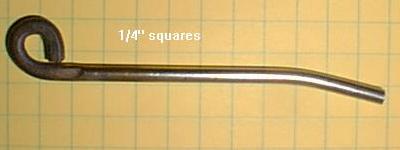
Target Reinforcement Brace, using a Small Rod. Instead of sacrificing the coinbox lid, this version of the target reinforcment brace uses uses a 1/8" stainless wire rod about 4 inches long. The rod is formed to extend from an existing playfield screw to the top of the depression in the stock slot target switch backing plate. According to Ken S (who came up with this idea), this fix has held after a lot of use. A 1/8" stainless steel wire rod was bought from a local welding supply company. The rod is then heated red hot before bending (use a Mapp gas torch, but a propane torch should also work). After forming the "eye" (where the screw attaches, see the picture below), quenched it in water (basically heat treating the rod to resist bending). The eye has a slight up bend that can't be seen in the photo. Bends other than the eye were made cold.
End of Twilight Zone Slot Machine Switch modification. * Go to the Pin Fix-It Index at http://marvin3m.com/fix.htm * Go to Marvin's Marvelous Mechanical Museum at http://marvin3m.com |