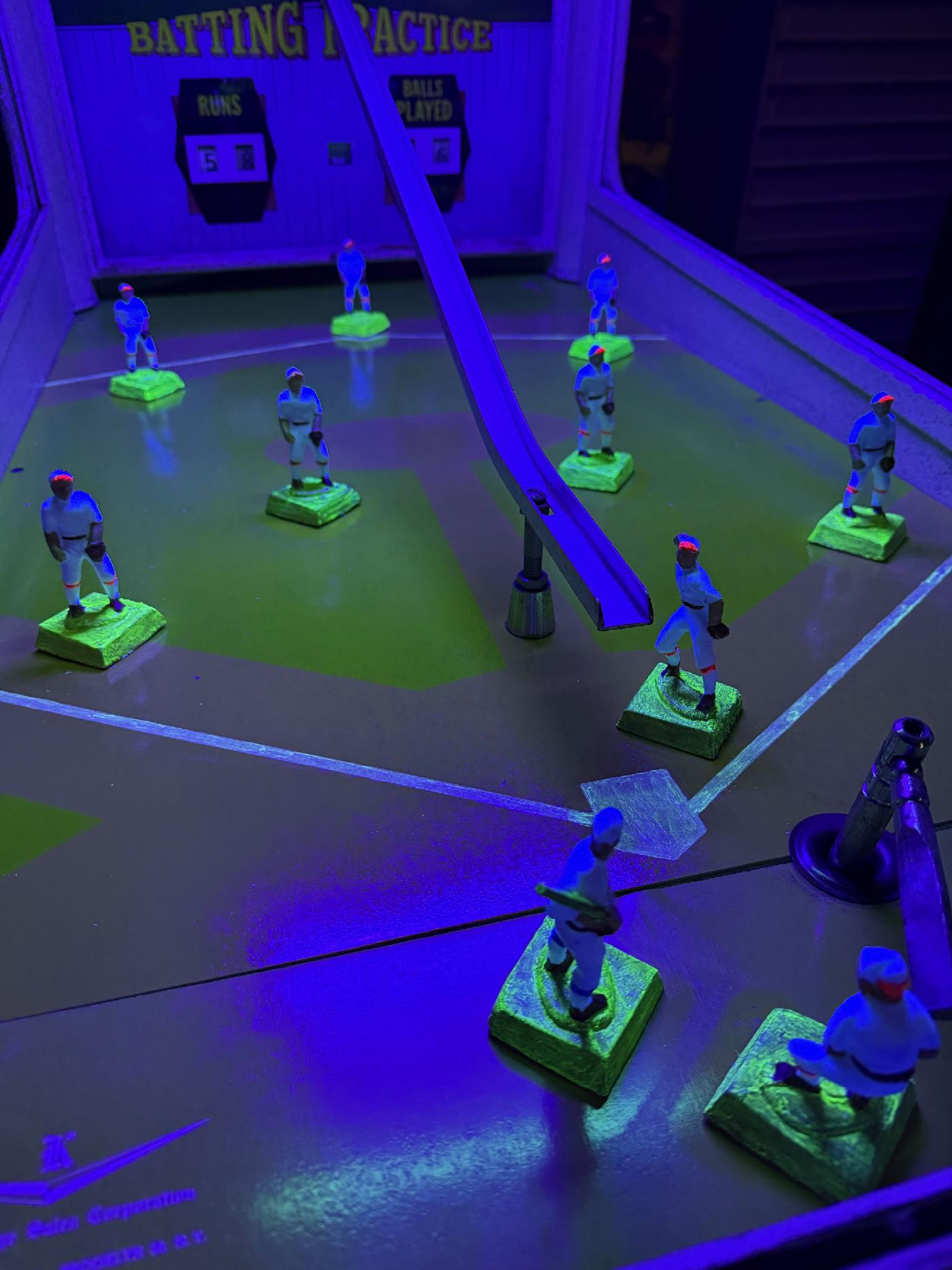
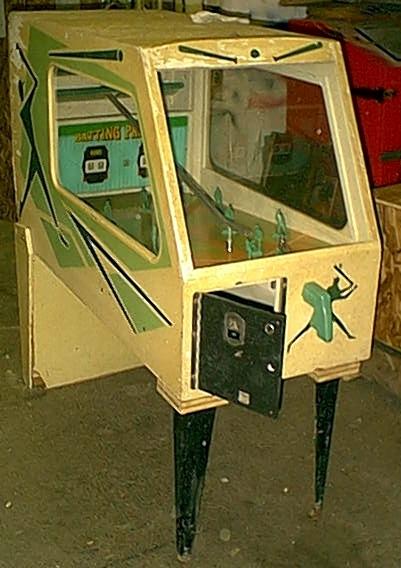
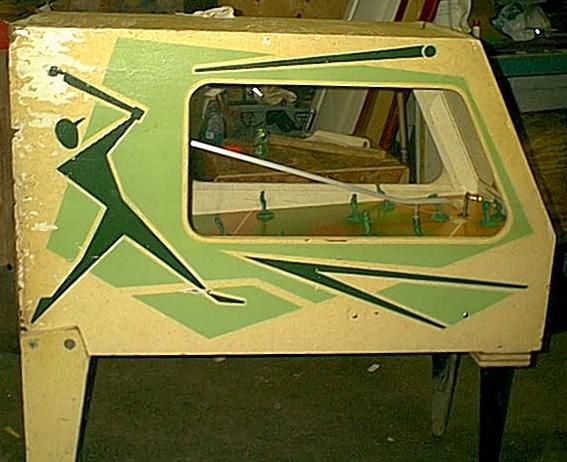
,
a deck represented 1,2,3 or 4 runs.
Unfortunately unlike the 1941 Scientific Batting Practice and the
1958 Keeney League Leader, the Irving Kaye Batting Practice does
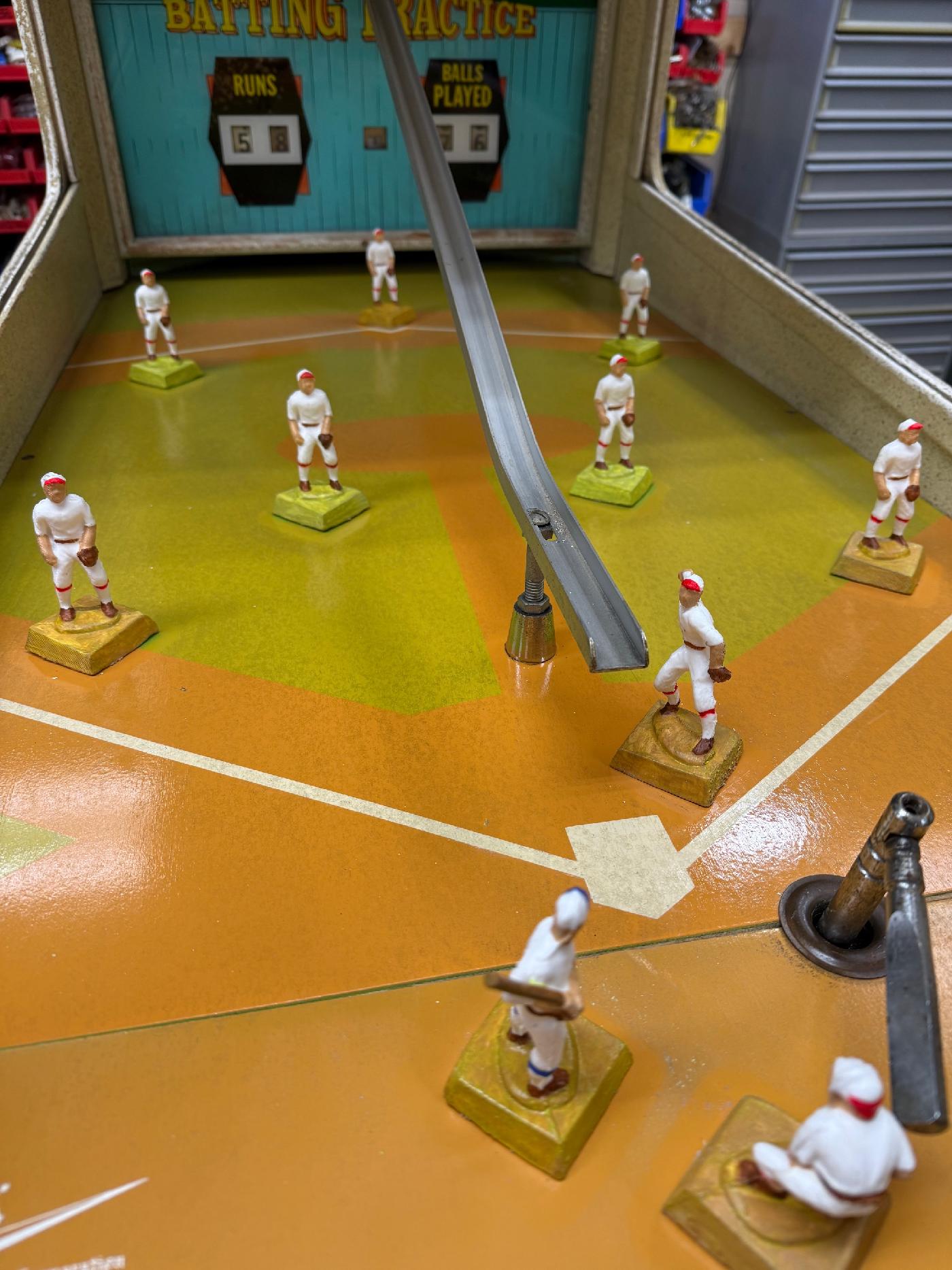
not score player positions on the infield diamond. Instead the player gets 1,2,3 or 4 runs
depending on the deck hit by the ball (higher decks yield more runs.)
The runs scored and balls pitched are tracked by Bally score reels in the backglass.
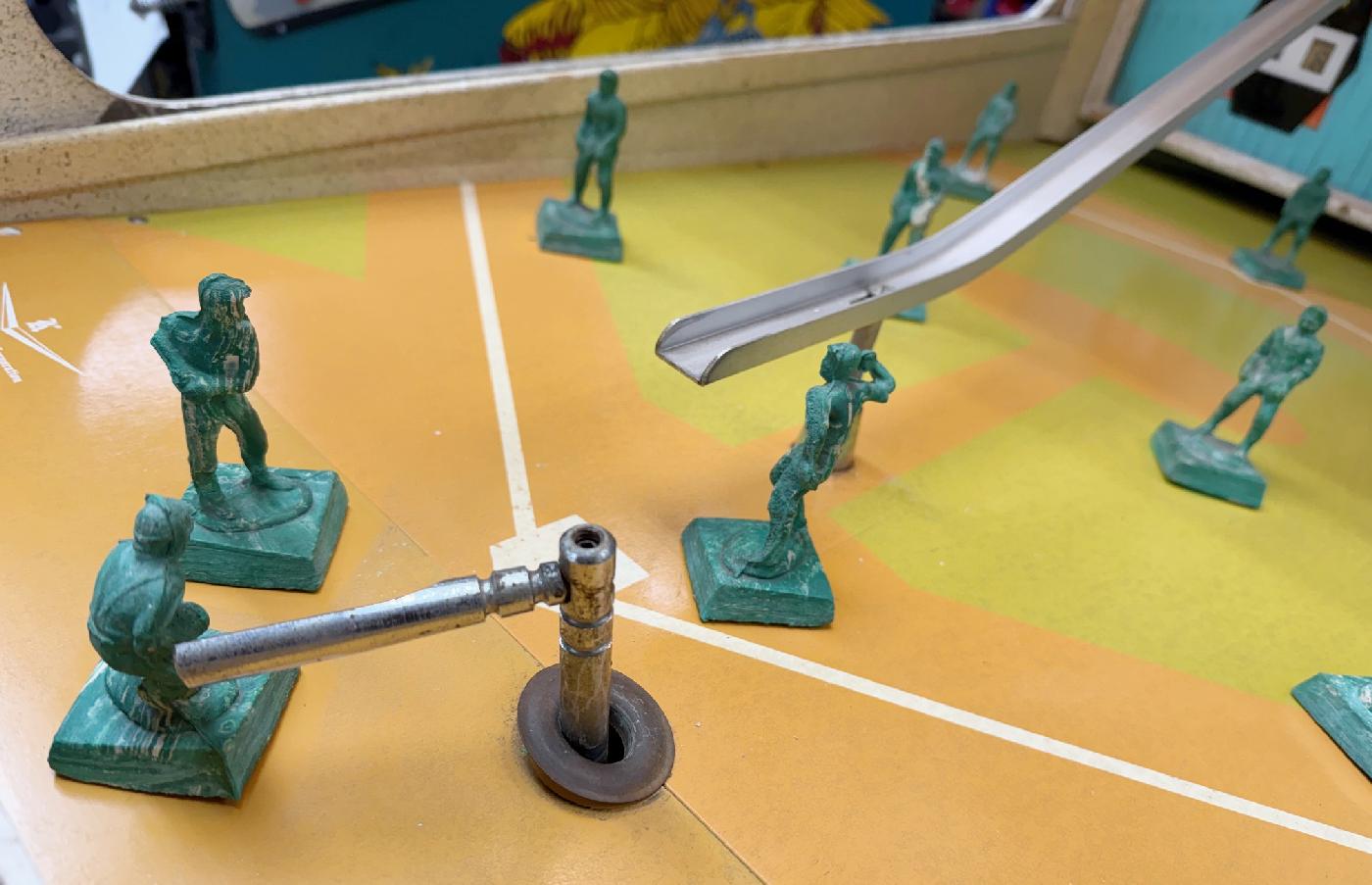
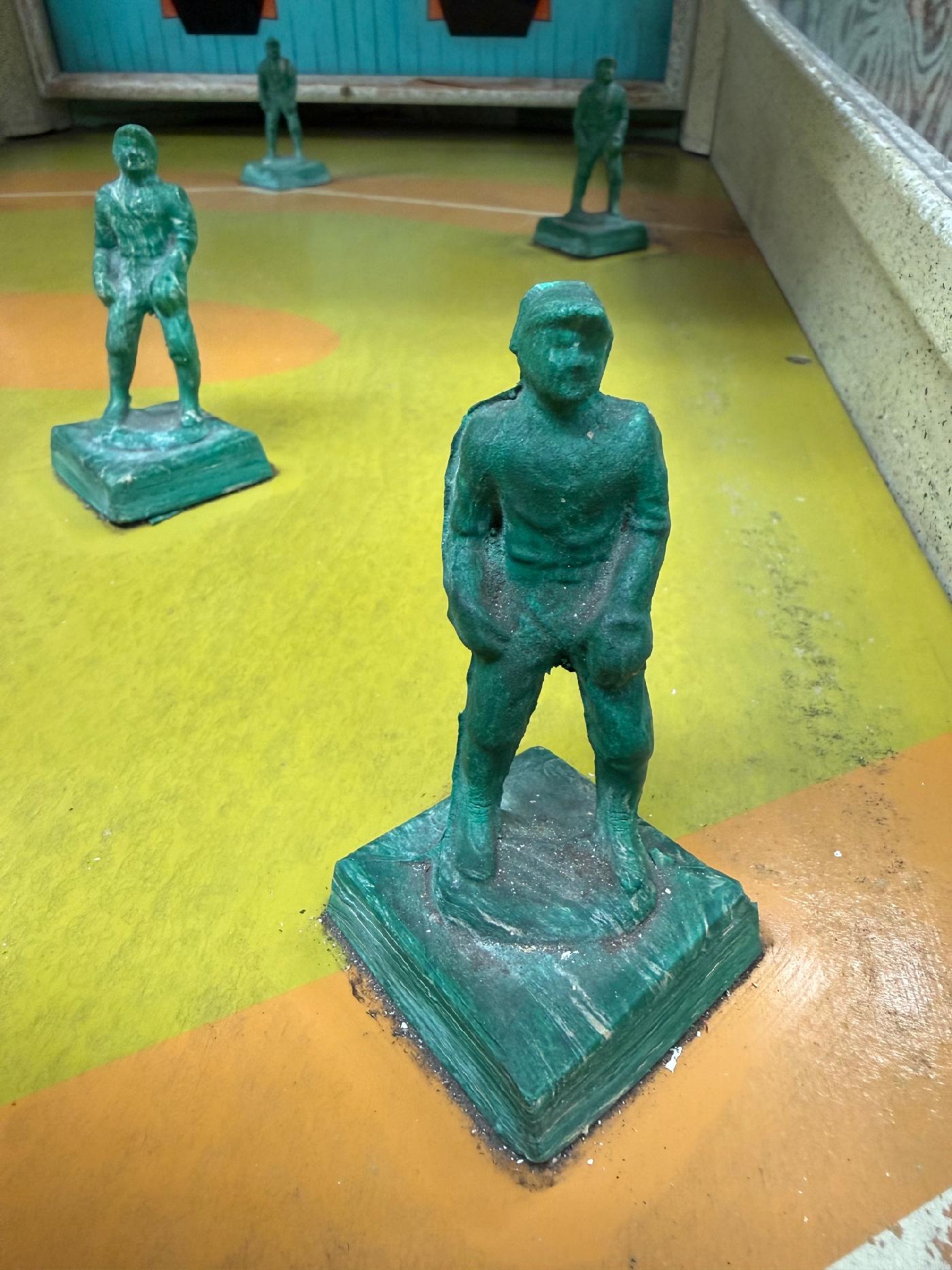
The playfield men are frankly, more like green army men than baseball players.
They serve no purpose other than decoration. It's too bad they are not painted
like the players on the 1941 Scientific Batting Practice. They are flexible,
and the green plastic has white swirls from the injection molding. From constant
ball impacts, the playfield men tend to crack at the ankles. There is no way
to prevent this. For this reason I have 3d scanned the fielders, batter, pitcher
and catcher. 3d printing these men in PLA has proved to work well. It also
fixes the batter issue (where the bat usually break off the player.) To mount
the new players, a 1/2" hole about 1/4" deep needs to be drilled into the player's base
using a brad-point drill bit. Then using JB Weld, a 1" long 1/4-20 bolt can be glued to the bottom of
the replacement player (the bolt head glues into the new 1/2" hole in the player's base.)
That's how the men are attached to the playfield.
The batting mech for this game is purely mechanical. Meaning the harder the
player squeezed the trigger, the harder the bat/ball were hit. The front legs
are dinette style round legs.
Operator adjustable game from 15 or 20 or 25 balls pitched. Extra balls can be
earned for a good score (or replay, operator selectable.) The balls are solid
plastic and .965" (24.5mm) diameter and 10 grams weight. The weight is important
or the will not play correct. Game plays with a minimum of five balls,
but probably came with ten balls when new. The chain that delivers the balls
to the top ramp can have three or four lift gates. The more lift gates, the
faster the game plays. My game had both chains. But what I did was to split
apart the three lifter chain and cut it, adding three more lifters, spaced evenly
between the original three lifters. This made
my chain have six lifters. Frankly the game is just too slow with a three or four
lifter chain. The six lifter chain made the game play much better, with far
less time wondering, "when will it pitch a ball??"
The lift motor is marked UMC at 50volts and about 27rpm. I would have thought
the motor would be a Molen motor (Bally's motor company), but on my game
it's UMC. The gears inside the gearbox are nylon. On my bearbox the last gear
slipped on it's shaft, and would not lift the balls.
Had to insert a small stainless steel pin in the gear/shaft
to prevent gear slippage.
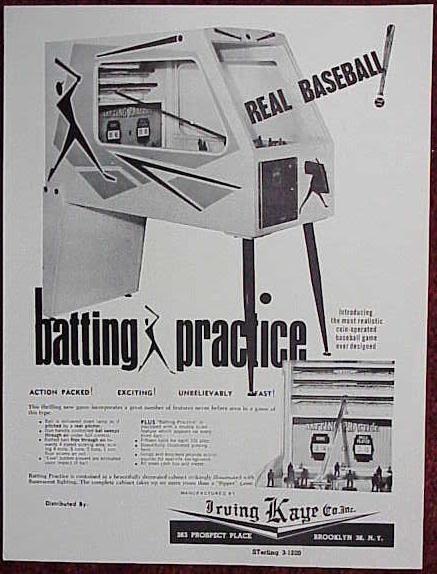
Although marketed by Irving Kaye, the Batting Practice games were built by Bally
using Bally parts at the Belmont Avenue Bally plant.
In fact the score reels, coin door, score motor, and stepper units were all Bally parts.
Mr. Irving Kaye himself was vice president of the Board of Directors for Bally Manufacturing
Corporation, since he was one of the main investors of Bally in 1963 (about the
time Bally introduced hopper style slot machines.)
The cabinet paint on Batting Practice starts with a bright white base coat. Then
a specialty finish called Zolatone in off-white is applied over the bright white base. This gives
a speckled finish. Then two different green overlays are painted on top of this
to give the cabinet it's baseball paint design.
If you have this game for sale please contact me at
cfh@provide.net